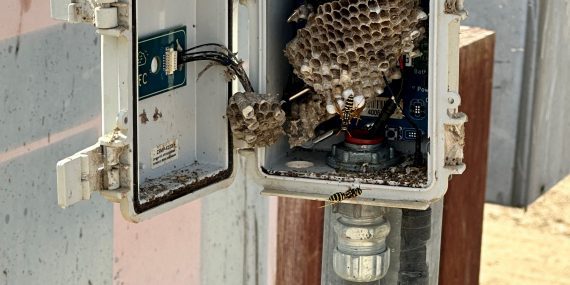
Someone stole the solar battery charger and cable gland from Zenseio TeleFarm device — but the wasps didn’t mind. They saw the vacancy and moved right in.
Our friends at REDtrac got quite the surprise opening the door… proving once again that in Ag IoT, it’s not just data that finds its way in — nature does too.
We’re incredibly proud to support groundbreaking research at the Jack and Laura Dangermond Preserve, where a team from the Earth Research Institute and Geography Department at UC Santa Barbara is pushing the boundaries of ecohydrological monitoring.
“Zenseio has been key in establishing our remote ecohydrological observatory in the Jack and Laura Dangermond Preserve. We deployed meteorological stations and soil moisture sensors across an upland coast live oak woodland transect to monitor oak water stress and develop an early warning system for drought-related tree stress. With the help of Zenseio, we established our own LoRa telemetry network of sensors in this remote preserve without any cell reception or internet and now maintain a live dashboard of the transect conditions. Their support and dedication to every single detail has been top notch since day one, and it is very evident how knowledgeable they are in this industry.” – MD Shadman Amin, PhD Researcher, UCSB.
We love helping researchers and innovators bring connectivity and insight to even the most remote locations.
Curious how wireless telemetry can empower your environmental monitoring projects? Let’s talk!
“I’ve used hundreds of Zenseio telemetry units and have had great success with their reliability, data accuracy, and ease of integration into my irrigation monitoring system.” — Hunter, Ag Tech Advisor
Hunter captured this great shot while deploying one of our Zenseio telemetry units in a beautiful field setting. Reliable data is the backbone of efficient irrigation and sustainable agriculture—and we’re proud that our solutions make it easier for professionals like Hunter to optimize operations and conserve resources.
A huge thanks to Hunter for trusting Zenseio as part of his digital agriculture toolbox!
Agriculture today faces a host of complex challenges that test the resilience and adaptability of farmers worldwide. From fragmented agricultural markets and resource scarcity to unpredictable weather patterns and poor infrastructure, modern farmers face numerous obstacles. Zenseio’s IoT-based telemetry solutions for precision agriculture offer a pragmatic approach to these issues, empowering stakeholders with data-driven insights to optimize agricultural operations. Let’s explore the primary challenges in agriculture and how Zenseio’s telemetry technology is paving the way for practical, sustainable solutions.
1. Market Fragmentation in Agriculture
Agriculture is composed of diverse sub-sectors, each with unique needs and challenges—crop production, livestock management, agrochemicals, and more. Compounding these complexities are regional variations in climate, terrain, and government regulations. Zenseio’s compact yet powerful telemetry solutions are versatile, allowing seamless integration across different agricultural applications and bridging the gap between complex ecosystem needs. By collaborating with ecosystem partners, Zenseio ensures that its technology can adapt to diverse requirements and simplify operational complexities for both small-scale and large-scale farms.
2. Addressing Natural Resource Constraints with Precision Agriculture
With freshwater scarcity, soil degradation, and biodiversity loss, resource constraints present formidable challenges for sustainable agriculture. Zenseio’s telemetry devices monitor critical factors like soil moisture, weather conditions, and water usage, helping farmers make informed decisions to conserve resources. By detecting early signs of crop stress and providing comprehensive data on resource use, Zenseio aids farmers in optimizing inputs, reducing waste, and supporting sustainable land use while complying with environmental regulations.
3. Connectivity Solutions for Remote Agricultural Infrastructure
Many agricultural areas lack reliable electricity and cellular coverage, making it difficult to deploy traditional technology solutions. Zenseio’s low-power, long-range IoT devices leverage radio technologies like LoRaWAN and LTE-M, ensuring connectivity even in remote locations without power outlets. With multi-carrier SIMs and robust device certifications, Zenseio’s devices provide dependable network operability across diverse geographies. Zenseio’s online diagnostic portal further enables remote monitoring and troubleshooting, minimizing the need for time-consuming trips to remote sites and maximizing system uptime.
4. Resilient Hardware for Harsh Agricultural Environments
Agricultural environments are often unforgiving, with extremes in temperature, moisture, and UV exposure that can degrade equipment. Zenseio’s hardware is specifically engineered to withstand these conditions, with features such as rugged enclosures and industrial-grade batteries or solar-powered options for consistent, long-lasting performance. Designed with durability in mind, Zenseio’s devices, once correctly installed, resist the corrosive effects of moisture, UV rays, temperature fluctuations, and minor mechanical stresses, ensuring reliable operation even in challenging agricultural conditions.
5. Flexible Solutions for Seasonal Cycles and Workforce Variability
Agriculture’s seasonal nature, marked by peaks in labor and resource demands, requires adaptable solutions that can respond to these fluctuations. Anticipating these seasonal shifts, Zenseio proactively manages inventory, staffing, and support resources to handle both high and low demand periods. Zenseio’s telemetry systems are easy to deploy and scale, with annual billing options that align with agricultural financial cycles. Equipped with long-lasting batteries, this scalable solution offers consistent, uninterrupted support throughout the agricultural cycle, reducing the logistical and financial burdens of seasonal deployment and maintenance.
The core premise of Zenseio’s IoT telemetry is to enable remote monitoring of production systems, eliminating the need to drive to multiple sites for manual checks. This reduces peak demand for personnel and equipment used to monitor sensors and irrigation systems—needs that tend to fluctuate across the agricultural cycle. By minimizing these variable demands, Zenseio helps farmers optimize their workforce and transportation resources, driving greater efficiency year-round.
6. Solutions for Underinvestment in Agricultural Technology
Low profit margins, high risks, and extended business cycles have traditionally constrained investment in agricultural technology. Zenseio addresses these challenges with affordable, reliable, and low-maintenance IoT telemetry devices designed for longevity. In addition, Zenseio collaborates within a diverse ecosystem of AgTech companies to integrate with specialized sensors and application software. This collaborative approach allows Zenseio to deliver versatile, powerful, and cost-effective vertical solutions tailored to specific precision agriculture applications. By providing real-time data and actionable insights, Zenseio enables farmers to enhance operational efficiency, boost yields, and swiftly respond to issues like irrigation system malfunctions, resource depletions, and sudden weather changes—ultimately minimizing losses from unpredictable events.
A Path Toward Sustainable Agriculture
As the agricultural sector moves toward data-driven and resource-efficient practices, Zenseio’s IoT telemetry solutions are helping to bridge the gap between traditional methods and modern technology. By addressing the unique challenges faced by the agricultural sector, Zenseio empowers Ag customers to make data-informed decisions, optimize resource use, and increase productivity. Through ongoing collaboration and innovation, Zenseio is committed to fostering a more sustainable and resilient agricultural future, empowering farmers in North America and worldwide.
Interested in learning more about how Zenseio’s IoT telemetry solutions can transform your farming operations? Contact us to explore how our precision agriculture technology supports sustainable farming.
In today’s rapidly evolving agricultural industry, the Internet of Things (IoT) plays a pivotal role in enhancing productivity, efficiency, and sustainability. Two key cellular wireless communication technologies enabling IoT solutions are LTE and LTE-M. Understanding the differences between these technologies is crucial for making informed decisions about deploying IoT devices in agricultural settings.
What is LTE?
Long-Term Evolution (LTE), commonly known as 4G LTE, is a high-speed cellular wireless communication standard designed for mobile devices and data terminals. It provides high data transfer rates, low latency, and robust performance, making it ideal for consumer devices and applications requiring substantial bandwidth.
Key Features of LTE:
High Data Rates: Supports fast download and upload speeds suitable for streaming video, online gaming, and other data-intensive applications.
Low Latency: Offers reduced delay in communication, essential for real-time applications.
Broad Coverage: Widely available in urban and suburban areas, providing extensive network access.
What is LTE-M?
LTE-M, or LTE Cat-M1, is a variation of LTE specifically designed for machine-to-machine (M2M) communication and IoT applications. It is optimized for lower data rates and extended battery life, making it particularly suited for IoT devices that require reliable, long-term connectivity but do not need high-speed data.
Key Features of LTE-M:
Optimized for IoT: Efficiently handles small data packets, ideal for many IoT applications like sensor data transmission.
Extended Battery Life: Devices can operate for prolonged periods on a single battery charge due to lower power consumption.
Enhanced Coverage: Improved penetration in challenging environments like basements, remote rural areas, and underground facilities.
Cost-Effective: More economical for low-bandwidth applications compared to traditional LTE.
Why LTE-M Matters for IoT in Agriculture
In agriculture, IoT devices are increasingly used for monitoring soil moisture, weather conditions, livestock tracking, and equipment management. LTE-M offers several advantages for these applications:
Long Battery Life: Essential for devices placed in remote locations where frequent battery replacement is impractical.
Better Rural Coverage: Enhanced connectivity in rural and remote areas ensures reliable data transmission from agricultural fields.
Lower Costs: Reduced operational expenses due to lower data plan costs and longer device lifespans.
Scalability: Supports a large number of connected devices, enabling farmers to expand their IoT networks as needed.
While LTE remains vital for high-speed internet and communication needs, LTE-M is increasingly becoming the standard for IoT applications in agriculture. Its extended battery life, improved rural coverage, cost efficiency, and scalability make it an ideal choice for deploying IoT solutions that can revolutionize farming practices.
In the realm of Internet of Things (IoT) technologies, LoRa and LoRaWAN are often mentioned together, but they serve distinct roles in communication. This article provides a brief overview to clarify the differences between the two terms and their roles in IoT applications, particularly in agriculture.
LoRa, short for Long Range, is a proprietary wireless modulation technique developed by Semtech for long-range, low-power communication. It uses a modulation method called chirp spread spectrum (CSS) to achieve long-distance transmission with very low energy consumption. Operating on various unlicensed frequency bands, LoRa enables devices to communicate over several miles, even in rural or challenging environments.
While LoRa refers to the physical layer technology, it is also used by third parties to create proprietary solutions based on LoRa radio technology. These solutions may offer functionalities similar to LoRaWAN but remain proprietary and are not based on open standards. This means they might not be interoperable with devices and networks from other vendors, potentially leading to vendor lock-in.
LoRaWAN, standing for Long Range Wide Area Network, is an open standard network protocol built on top of LoRa. It defines the communication protocol and system architecture for managing network communication between LoRa devices and gateways. LoRaWAN adds an additional layer of functionality by specifying how devices communicate with network gateways and how data is handled in the network to ensure secure and reliable communication. This includes features like end-to-end encryption, device authentication, and network management.
One of the key distinctions is that LoRaWAN is an open standard protocol, governed by the LoRa Alliance, which promotes interoperability and widespread adoption across various industries. In contrast, while LoRa technology itself is proprietary to Semtech, third-party proprietary solutions based on LoRa can further limit interoperability. The use of open standards like LoRaWAN allows for greater collaboration, flexibility, and scalability, as manufacturers and developers can build compatible devices and applications without being tied to a single vendor or facing licensing restrictions. This openness fosters innovation and drives down costs, benefiting users and the industry as a whole.
Advantages of Open Standards for Farmers
For farmers and growers, the adoption of open standards like LoRaWAN offers significant advantages. A primary benefit is the avoidance of vendor lock-in. Since LoRaWAN is an open protocol, farmers are not dependent on a single vendor for their IoT solutions. If a vendor goes bankrupt, raises subscription prices, or shifts market focus, farmers can switch to other vendors without losing their existing investments in devices and infrastructure. The ability to mix and match devices and services from different providers ensures continuity and protects against unforeseen changes in the vendor landscape. This flexibility ultimately leads to more sustainable and cost-effective agricultural operations.
In contrast, proprietary solutions based on LoRa technology may lock farmers into a single vendor’s ecosystem. Should issues arise with that vendor, farmers might face significant costs and disruptions in replacing hardware and reconfiguring systems. Open standards mitigate this risk by ensuring that equipment and software from different sources work seamlessly together.
Application in Agriculture
LoRa’s long-range capabilities enable sensors and devices to monitor soil moisture, weather conditions, and crop health from remote locations without frequent maintenance or battery changes. LoRaWAN builds upon this by providing a scalable and secure open-standard network for these devices. By leveraging an open standard like LoRaWAN, agricultural IoT solutions can benefit from a broad ecosystem of compatible devices and services. This allows farmers to collect data from numerous sensors spread across large fields and transmit it to centralized systems for analysis. The result is enhanced efficiency and productivity in farming operations, with the added assurance that their technology investments are protected against vendor-related risks.
To learn more about LoRaWAN, and how it allows Zenseio devices to help optimize crop yields and more, visit: LSMP | TeleFarm.
Welcome back to our exploration of agricultural data collection. In Part I, we discussed the evolution of soil moisture probes and data collection methods up to the early 2010s. In this second part, we’ll delve into the most impactful developments in agricultural sensors and devices since then. While critical sensors like soil moisture probes have seen incremental improvements, the real advancements have been in the technologies that support them—most notably cloud storage and IoT connectivity options like LoRaWAN and LTE-M, which are transforming produce farming.
Cloud Storage in Agriculture
The advent of cloud storage has revolutionized how growers track and store vast amounts of valuable telemetry data. By providing a secure and scalable platform that eliminates the need for local data storage, cloud solutions enable farmers to access their data anytime, anywhere, from any device. This capability is particularly beneficial for large-scale produce operations where data needs to be accessible to multiple team members simultaneously.
Cloud-based analytics further empower growers to fine-tune and coordinate their farming practices. Advanced tools can process large datasets to provide insights on irrigation efficiency, soil health, and yield predictions. This level of data-driven decision-making was previously unattainable and is now essential for optimizing resource usage and maximizing crop yields.
IoT Connectivity Transforming Produce Farming
Just as cloud computing has streamlined data storage and analysis, the development of IoT (Internet of Things) platforms has transformed how growers manage data from various sources. A well-implemented agricultural IoT ecosystem consolidates data from diverse sensors—soil moisture probes, weather stations, nutrient monitors, and more—into a single, convenient access point. This unified approach simplifies monitoring and allows for more comprehensive data analysis, enhancing decision-making processes in produce farming.
IoT connectivity enables real-time monitoring and alerts, allowing growers to respond promptly to changing conditions. For example, if soil moisture levels drop below a certain threshold, an automated irrigation system can be activated, ensuring optimal water usage. This level of automation and integration reduces labor costs and increases operational efficiency, which is crucial for managing large fields of fruits and vegetables.
Expanding Connectivity with LoRaWAN and LTE-M
To effectively gather and transmit data from a wide array of sensors across expansive fields, reliable and efficient connectivity solutions are essential. Two leading technologies in this space are LoRaWAN and LTE-M, both of which offer significant benefits for agricultural applications.
Benefits in Agriculture
Long-Range Communication: Both LoRaWAN and LTE-M enable data transmission over long distances, making them ideal for large farming environments where sensors are spread out.
Low Power Consumption: Designed for IoT applications, these technologies consume minimal power, allowing sensors to operate for extended periods on battery power, thus reducing maintenance costs.
Real-Time Data Transmission: They support real-time monitoring of soil conditions, weather data, and equipment status, enabling immediate responses to changing conditions.
Scalability: Both technologies can handle a large number of connected devices, making it easy to expand sensor networks as farming operations grow.
Applications in Produce Farming
Optimizing Irrigation Schedules: Soil moisture sensors transmit data to inform precise irrigation management, conserving water, reducing fertilizer runoff, and enhancing crop growth.
Monitoring Microclimates: Weather stations provide localized data on temperature, humidity, and wind conditions, aiding in disease prevention and pest control.
Equipment Monitoring: Real-time data on machinery performance helps in predictive maintenance and efficient resource allocation.
By incorporating these connectivity options, growers can deploy a comprehensive network of sensors without worrying about connectivity issues or excessive power consumption. This integration is crucial for the modern produce farmer aiming to maximize yield and efficiency.
Zenseio’s Role in Connectivity Solutions
At Zenseio, we specialize in providing robust IoT connectivity solutions that bridge the gap between sensors in the field and cloud-based applications and analytics. Our focus is on delivering reliable connectivity through technologies like LoRaWAN and LTE-M, enabling seamless data transmission from various agricultural sensors.
We collaborate with partner companies and customers to integrate sensor connectivity into cloud applications and analytics platforms. By doing so, we ensure that growers can leverage the full potential of their data without the complexities associated with connectivity challenges.
The Future of Agricultural Data Collection
These innovations have been instrumental in propelling the upward trend of agricultural data collection that continues today. Looking ahead, we anticipate significant advancements in both sensor technology and data analysis methods that will further revolutionize produce farming.
Advancements in Soil Nutrient Sensing
On the sensor front, there’s a concerted effort by manufacturers to develop better and more reliable soil nutrient sensing capabilities. Modern sensors are becoming increasingly sophisticated, aiming to measure a range of soil nutrients such as nitrogen (N), phosphorus (P), potassium (K), and soil pH in real-time with higher accuracy and reliability. This level of precision will allow growers to make even more informed decisions about fertilization, leading to:
Optimized Nutrient Management: Applying the exact amount of fertilizer needed at the precise time to meet crop requirements.
Cost Savings: Reducing excess fertilizer use lowers input costs.
Environmental Benefits: Minimizing nutrient runoff protects local waterways and reduces environmental impact.
As these advanced soil nutrient sensors become more prevalent, integrating them into existing IoT ecosystems will be crucial. The data collected can be combined with other environmental data to provide a comprehensive picture of soil health, enabling precision agriculture practices to reach new levels of efficiency.
Integration of Advanced Technologies
We also anticipate further integration of artificial intelligence and machine learning algorithms to analyze the vast amounts of data collected from advanced sensors, providing deeper insights and predictive capabilities. Technologies like edge computing are emerging, allowing data processing to occur closer to the data source, reducing latency and bandwidth usage.
For produce growers, these advancements mean:
Enhanced Precision Agriculture: Utilizing detailed soil nutrient data to apply fertilizers only where needed.
Predictive Analytics: Anticipating nutrient deficiencies or soil health issues before they impact crop yield.
Sustainability: Optimizing resource usage to reduce waste and environmental impact, promoting eco-friendly farming practices.
At Zenseio, we are at the forefront of these technological advancements in connectivity. By focusing on the crucial link between advanced sensors and cloud platforms, we empower growers to optimize their operations through cutting-edge technology without the connectivity hurdles.
To discover how Zenseio’s connectivity solutions can integrate your advanced sensors with cloud applications and analytics, visit our Products Page at Zenseio.com.
By incorporating advanced sensor technologies and robust connectivity solutions, growers are better equipped than ever to meet the challenges of modern agriculture. Stay tuned for more insights into how technology is shaping the future of farming.
In the realm of commercial agriculture, soil moisture probes stand out as some of the most critical agricultural sensors. These devices offer invaluable insights into soil conditions, helping growers make informed decisions. Since the 1990s, sensor technology has advanced rapidly. This post, the first in a two-part series, explores the evolution of soil moisture probes and the methods used to collect their data.
Sensor Technology in the 1990s and Earlier
Before the late 1990s, soil moisture probes were relatively simple, utilizing resistance-based and tension measurements. Farmers had to manually gather data, calibrate, and maintain the sensors, and record moisture levels at specific intervals. While these probes provided groundbreaking insights for the time, the process of checking each probe and noting down individual measurements was both tedious and time-consuming.
Data Loggers in the 2000s
With advancements in sensor technology, data collection methods also improved. Dielectric sensors (1) became popular due to their enhanced accuracy in measuring soil moisture. The introduction of data loggers revolutionized the field. These devices, equipped with onboard memory, automated data storage at regular intervals. Although growers still had to visit the site to retrieve data, they could now access historical soil moisture data and collect it all at once, reducing the labor and resources required.
Mid-2000s to 2010s: Precision Farming Systems
As technology continued to progress, soil moisture probes began incorporating sensors at various depths (2), measuring not only soil moisture but also temperature and salinity. These probes integrated with other sensors like weather stations and data management platforms, enabling real-time monitoring and remote data retrieval. Growers could now collect comprehensive soil moisture data in real-time, without needing to physically access the sensors, thus streamlining the data collection process and facilitating data-driven decision-making.
To learn more about the evolution of soil moisture probes and the ongoing innovations in IoT connectivity, low-power transmission, and Cloud connectivity, read part II at Zenseio.com.
In modern commercial agriculture, the use of Internet-of-Things (IoT) sensors has revolutionized how we produce food. IoT technology is now essential for optimizing yields, conserving resources, and ensuring sustainable practices. Within the realm of agricultural IoT, various sensors play crucial roles in monitoring and managing key environmental factors. This blog post provides an overview of common IoT sensors used in agriculture, including temperature sensors, rain gauges, soil moisture probes, pressure transducers, and weather stations.
Rain Gauges
Water is fundamental to all living things, but life thrives only with the right amount. Accurate rainfall measurement is crucial because too much or too little water can be detrimental to crops. IoT-enabled rain gauges provide farmers with the data needed to make informed decisions about irrigation schedules, preventing overwatering and conserving water. These sensors allow farmers to take a proactive approach to water management, working alongside nature.
Soil Moisture Probes
Real-time rainfall data doesn’t provide the complete picture of soil moisture availability. To understand how much moisture is actually accessible to plants, growers need to monitor soil moisture directly. Soil moisture probes, equipped with IoT capabilities, offer precise insights into soil moisture content, soil temperature, and salinity at various depths. This data helps farmers implement targeted irrigation strategies, minimize water and fertilizer wastage, optimize yields, and prevent water stress in crops.
Temperature Sensors
The humble thermometer may be the simplest yet very important sensor in agriculture. Many crops require specific temperature ranges to grow optimally, making temperature a critical metric for growers to monitor. Quickly detecting and acting on freeze and heat stress conditions can mean the difference between a successful and a lost season. Temperature sensors are extensively used to monitor ambient temperatures in both outdoor and indoor farming environments. By receiving real-time data on temperature fluctuations through IoT temperature sensors, farmers can make informed decisions about their growing operations.
Pressure Transducers
Modern irrigation systems are often complex and automated, but they all require consistent water pressure to operate effectively. Pressure transducers are IoT sensors used in irrigation networks to ensure water pressure levels are within the optimal range. By measuring pressure and detecting its abnormalities, these sensors help farmers quickly detect leaks or blockages, assess system performance, and regulate water distribution. Additionally, submersible pressure transducers help growers to monitor water levels in reservoirs, wells, and rivers used for irrigation. Given the importance of precise moisture levels in agriculture, ensuring irrigation systems function correctly is crucial.
Flow Meters
Flow meters are another essential IoT sensor in modern agriculture, particularly for managing irrigation systems. These devices measure the rate at which water flows through irrigation pipes, providing real-time data on water usage and costs. In some areas, water metering is also required for compliance. By integrating IoT-enabled flow meters, farmers can monitor and control water distribution with greater precision. This ensures that each section of the farm receives the right amount of water, reducing wastage and promoting efficient water management.
Weather Stations
Monitoring the general environment around crops is as important as tracking moisture levels, and IoT provides an excellent solution. All-in-one IoT weather stations contain a suite of integrated sensors, including temperature, humidity, wind speed, and atmospheric pressure sensors. These telemetry devices offer comprehensive data on these vital, environmental factors in one dedicated unit.
This article provides an overview of the key IoT sensors used in the agriculture industry, but many more sensors offer unique benefits to growers. Other relevant IoT sensors for agriculture include pyranometers (solar irradiance sensors), ultrasonic level sensors, dendrometers, and leaf wetness sensors. By leveraging these innovative technologies, farmers can navigate the complexities of modern agriculture with greater efficiency and resilience. For more information on IoT-integrated agriculture and how Zenseio devices unite these sensors to help growers maximize their potential, visit Zenseio.
IoT powered Precision Agriculture can be complex, especially when it comes to network infrastructure, and choosing a network solution can be one of the most consequential choices one can make. According to Grandview Research, the precision agriculture market is poised to reach $43 billion by 2025, emphasizing the industry’s growth potential. However, when deciding to adopt a network for IoT, the choice between utilizing cellular data and LoRa technology is not always clear cut, as each presents distinct advantages and disadvantages, which will be explored in this article.
POWER CONSUMPTION
Energy efficiency is one of primary considerations when implementing IoT in agriculture. LoRaWAN, the open standard protocol utilizing LoRa radio technology, adopts a reliable and simple method of defining three classes of devices to minimize protocol complexity and energy consumption. This approach ensures that devices in the field operate with optimal power efficiency. The significance of low power consumption becomes apparent when considering the remote and often off-grid locations of agricultural operations. LoRa’s ability to operate on minimal energy resources positions it as a sustainable and practical choice for many applications. Cellular devices can also operate with relatively low power consumption, but nearly always consume more power to operate than LoRa.
RANGE AND CONNECTIVITY
LoRa and Cellular can provide a long-range signal, though using gateways with Ethernet backhaul, LoRa devices can often be deployed to areas where cellular coverage is scant or nonexistent. This makes LoRa an excellent choice for remote areas that may lack existing cellular coverage or power sources. However, the existing robust cellular data infrastructure in many rural areas in the United States and elsewhere mean that in many use cases, cellular devices can be deployed easily with less setup that a LoRa powered device. In regions where cellular coverage is already well established, utilizing this cellular infrastructure might provide a seamless and reliable solution.
DATA COST
While the cost of deploying and maintaining sensor networks is a concern, the expense associated with data plans over time can be a decisive factor in choosing between LoRa and Cellular Data. For instance, smaller and medium scale farms may find it economically challenging to afford cellular connections for many devices drawing data from sensors in a large field or group of fields. The incorporation of SIM cards with monthly bills per device could outweigh the potential yield advantage, often making Ethernet gateway LoRa a more cost-effective alternative, especially in dense sensor node deployments. This being said, there are still associated costs with LoRa, such as gateway hardware and maintenance costs, and the convenience of Cellular connectivity may outweigh any additional cost for some.
SUMMARY
Choosing between Cellular Data and LoRa technology is a strategic decision that hinges on the specific needs and conditions of each farming operation. The considerations of location, terrain, power consumption, and data cost underscore the importance of a tailored approach to connectivity solutions. As the industry continues to embrace technological advancements, networking technology will continue to evolve with it, and these various strengths and weaknesses will change as well. Zenseio provides plug and play devices that use either LoRa or Cellular and provides dedicated consultation and support to help businesses choose the right option for their unique needs. To learn more about Zenseio and the network options we offer, visit: zenseio.com
Manage Cookie Consent
To provide the best experiences, we use technologies like cookies to store and/or access device information. Consenting to these technologies will allow us to process data such as browsing behavior or unique IDs on this site. Not consenting or withdrawing consent, may adversely affect certain features and functions.
Functional
Always active
The technical storage or access is strictly necessary for the legitimate purpose of enabling the use of a specific service explicitly requested by the subscriber or user, or for the sole purpose of carrying out the transmission of a communication over an electronic communications network.
Preferences
The technical storage or access is necessary for the legitimate purpose of storing preferences that are not requested by the subscriber or user.
Statistics
The technical storage or access that is used exclusively for statistical purposes.The technical storage or access that is used exclusively for anonymous statistical purposes. Without a subpoena, voluntary compliance on the part of your Internet Service Provider, or additional records from a third party, information stored or retrieved for this purpose alone cannot usually be used to identify you.
Marketing
The technical storage or access is required to create user profiles to send advertising, or to track the user on a website or across several websites for similar marketing purposes.