Does CSMP need a local gateway?
No. CSMP reports over supported LTE-M cellular service at the device location. Verify the carrier/service configuration and coverage where you will mount it.

Send readings from soil probes, weather stations, and irrigation or water-level sensors over LTE-M. CSMP-4103 uses supported cellular service at each site.
01 / CSMP
CSMP-4103 uses existing LTE-M carrier infrastructure. It’s a fit for standalone pump stations, reservoirs, or fields spread across a service area where you want each site to report independently over cellular.
02 / CSMP
Pair a compatible SDI-12 soil probe or weather station with instruments such as a pressure transducer, rain gauge, or flow meter. The device has three configurable general-purpose inputs and a selectable auxiliary power output for compatible sensors.
03 / CSMP
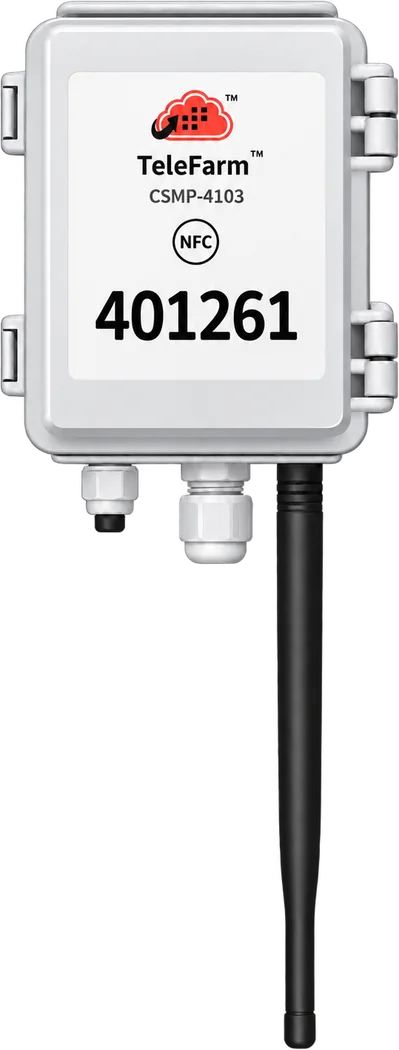
A UV-resistant NEMA 4X polycarbonate enclosure protects the electronics at exposed outdoor sites. A pressure vent, mounting bracket, and external antenna support field installation. Confirm operating limits for the conditions at your site.
04 / CSMP
ZenConfig™ lets you read and change supported settings from an NFC-enabled phone. Review device health and readings in Zenseio™ Dashboards or deliver measurements to your own application through a supported integration.
05 / CSMP
Specifications for new hardware. Choose supported instruments and a power configuration suited to your installation.
| Feature | Details |
|---|---|
| Connectivity | LTE-M cellular using supported service at each device location. No local LoRaWAN® gateway is required. |
| Sensor-bus selection | SDI-12 or RS-485 Modbus RTU. Both are included on new hardware; select one sensor bus at a time. |
| Sensor connections | One supported SDI-12 instrument plus three configurable general-purpose inputs. A multi-depth probe or weather station can supply several measurements through its single SDI-12 connection. |
| General-purpose inputs | Switch state and pulse counting; 0–24 V analog voltage, 4–20 mA current, resistance/thermistor and digital temperature modes on the inputs that support them. Available modes depend on the input and device hardware. |
| Modbus measurement support | RS-485 Modbus RTU: one sensor address, read functions 1, 2, 3 and 4. Current ZenConfig™ supports up to nine active read commands. Confirm the instrument’s register map and power requirements. |
| Sensor power | Selectable 5, 8, 9 or 12 V DC auxiliary output. Match the voltage and total sensor load to the installation; some instruments need continuous power. |
| Power options | Field-replaceable primary lithium battery or compatible SOLIK™ rechargeable solar setup. Multi-year battery life is possible, but depends on sensor load, sampling/reporting frequency, radio conditions and temperature. |
| Enclosure | UV-resistant polycarbonate, NEMA 4X, with pressure vent, external antenna and mounting bracket. |
| Enclosure dimensions | 4½ × 5¼ × 3 inches (approximately 114 × 133 × 76 mm). Allow additional space for mounting, cables and the antenna. |
| Reporting and alerts | Configurable reading/reporting schedules and supported high/low input thresholds. Delivery depends on network availability and the configured data or alerting service. |
| Configuration and service | Offline NFC configuration with ZenConfig™ on supported iPhone and Android devices. Offline USB firmware service with ZenUpdate™ in desktop Chrome on macOS and Windows, using a prepared laptop and supported adapter. |
| Published temperature range | Normal operation: −5 to +115 °F. Extended operation: −40 to +140 °F (−40 to +60 °C), with possible limits to radio performance and battery life. Sensor and rechargeable-battery limits also apply. |
| Data access | Send measurements to your application through the configured Zenseio™ data service. Zenseio™ Dashboards provides supported device health and sensor-history views. Access depends on the service and account. |
Reviewed
Confirm sensor compatibility, power requirements and LTE-M coverage before ordering. A cellular phone signal alone does not establish LTE-M service at the mounting point.
These are model specifications and supported workflows, not a fixed battery-life or coverage promise. Solar charging and connected instruments can impose narrower environmental limits.
06 / CSMP
Straight answers to help you choose the right setup.
No. CSMP reports over supported LTE-M cellular service at the device location. Verify the carrier/service configuration and coverage where you will mount it.
Yes. New CSMP hardware includes RS-485 Modbus RTU support. Match the instrument’s read functions, register map and power needs to the station. Select SDI-12 or Modbus as the active sensor bus; they do not run simultaneously.
Supported Zenseio™ dashboard views show reporting status, battery and radio trends, and sensor history. They help narrow the investigation and plan what to bring. Physical faults may still require an on-site check.