An agronomist, Sally Blair from Wilbur-Ellis, is describing the benefits of precision agriculture and soil moisture telemetry at a hop farm in Oregon.
“I think that the probes have really been able to let them cut back on soil on their irrigating because, with the drip line, you can’t really tell how much water a tree and plants are actually getting. So by having a probe schedule, then you can see how much water is truly going in there. And we’ve been able to minimize the leaching of the soil fertility and the fertilizer through. So we’re able to hold it in that profile, where all the roots are. So they can actually uptake the nutrients and we’re not leaching them all out by over irrigating. We have growers that are using them every day to look at how much irrigation they’re putting on. And they’ve really been able to save on like their power bill and on their water by just applying the amount they need and not overwatering.” – Sally Blair, agronomist at Wilbur-Ellis
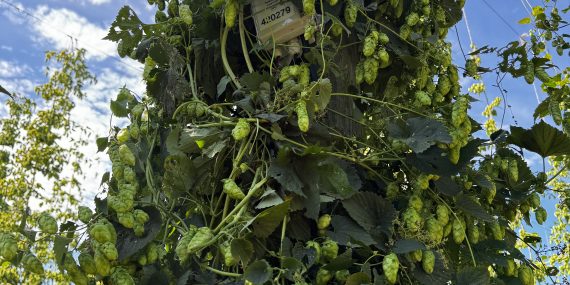
Sometimes it’s difficult to find telemetry devices in the overgrown vegetation. It’s amazing their radios still work over very large distances being completely immersed in layers of leaves.
“My experience with it has been very positive it’s taught me more about my irrigation than I thought I’d ever learn. The sensors and the graphs that I get from that, show me when to water and when I don’t need to water and if I have any issues in the fields with power outages or anything. That’s really very helpful with that as well.” – Ben, the co-founder of B&D Farms that specializes in the hop production
IoT sensor productization is an often overlooked, complex, specialized task that drastically impacts time-to-market and cost
“Hardware is hard” is not a cliché, especially for highly reliable industrial applications
Details:
As mentioned above, there is a significant challenge going from a well working application prototype to a product ready for real-life field deployments in terms of the required level of effort, specialized skillset, as well as development time and cost. What might work well in climate-controlled lab environment may behave erratically or unreliably under stressed environmental conditions where an industrial device is expected to operate reliably over the course of many years.
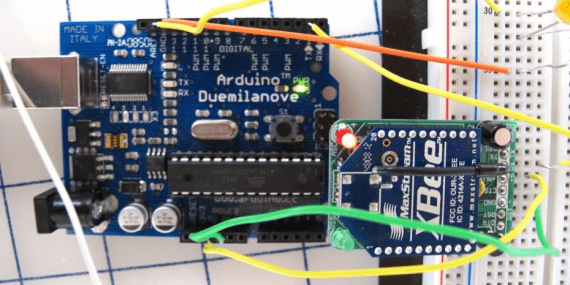
Oftentimes, productization aspect is an afterthought, despite being one of the most important factors deciding between a product’s success or failure. Without relevant experience to rely on, many customers fall into a trap of thinking that having their secret sauce firmware ported into an IC vendor’s evaluation board (EVM) is all it takes to create a product ready for deployment. What they don’t realize is that even though the EVMs they use often high quality and sometimes low cost, IC manufactures won’t sell them in any quantities larger than a few units to a single end customer and frequently have legal restrictions in fine print that these EVM’s are only for IC evaluation and product development, forbidden to be used as actual products. Another widely popular prototyping platform are Arduinos. While Arduinos have no legal restrictions as above, they are not reliable industrial grade products designed for industrial environments nor optimized for low power consumption. These solutions are great starting points on a long and arduous road to real industrial product development that may cost upwards of $100K and many months to finish-line. In particular, use of RF circuits, which are required for wireless communication, adds major productization complexity, schedule delays, as well as additional high development and regulatory compliance costs. There is a saying in the industry that “hardware is hard” – these are some of the reasons.
This is typically what prototyping looks like – far from production readiness
Manage Cookie Consent
To provide the best experiences, we use technologies like cookies to store and/or access device information. Consenting to these technologies will allow us to process data such as browsing behavior or unique IDs on this site. Not consenting or withdrawing consent, may adversely affect certain features and functions.
Functional
Always active
The technical storage or access is strictly necessary for the legitimate purpose of enabling the use of a specific service explicitly requested by the subscriber or user, or for the sole purpose of carrying out the transmission of a communication over an electronic communications network.
Preferences
The technical storage or access is necessary for the legitimate purpose of storing preferences that are not requested by the subscriber or user.
Statistics
The technical storage or access that is used exclusively for statistical purposes.The technical storage or access that is used exclusively for anonymous statistical purposes. Without a subpoena, voluntary compliance on the part of your Internet Service Provider, or additional records from a third party, information stored or retrieved for this purpose alone cannot usually be used to identify you.
Marketing
The technical storage or access is required to create user profiles to send advertising, or to track the user on a website or across several websites for similar marketing purposes.